These worksheets are crucial tools for learning, offering a variety of problems that can range from basic arithmetic to complex problem-solving. It is important for math worksheets to be leveled by grade because each grade has specific learning objectives and skill sets that students need to master. Grade-level alignment ensures that the content is appropriate for the students’ developmental stage and cognitive abilities, promoting effective learning and preventing frustration or boredom. Tailored worksheets help students build on their existing knowledge systematically, ensuring a solid foundation for more advanced mathematical concepts.
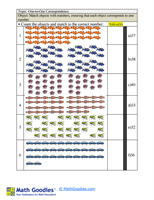
Grade 1 Math Worksheets – They include exercises on counting, addition, subtraction, and number patterns to help young students develop foundational numeracy. These worksheets often incorporate colorful illustrations and engaging activities to make learning enjoyable for children.
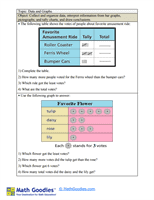
Grade 2 Math Worksheets – They include exercises on addition and subtraction, place value, counting, and number patterns, along with basic geometry, measuring lengths, and solving simple word problems. They often feature activities like filling in missing numbers, matching numbers with pictures, and solving basic math equations to reinforce understanding and fluency in these concepts.
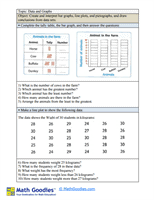
Grade 3 Math Worksheets – This series includes exercises such as solving word problems that involve addition, subtraction, multiplication, or division, and comparing fractions using visual models. They also feature tasks like measuring lengths in standard units, interpreting data from bar graphs, and calculating the perimeter of various geometric shapes.
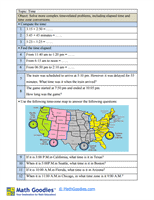
Grade 4 Math Worksheets – You will see exercises focusing on multi-digit multiplication and division, along with the use of factors and multiples. Additionally, there would be problems on fractions, including addition and subtraction with like denominators, as well as basic geometry concepts like understanding angles and calculating area and perimeter.
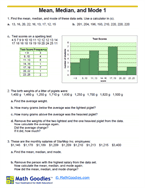
Grade 5 Math Worksheets – The problems include exercises on operations with fractions and decimals, such as addition, subtraction, multiplication, and division, as well as problems involving place value, rounding, and basic geometry concepts like area and volume. They also often feature word problems that require students to apply these mathematical operations in real-life scenarios to enhance their problem-solving skills.

Grade 6 Math Worksheets – Includes exercises such as solving multi-step word problems involving fractions, decimals, and percentages, as well as algebraic equations and inequalities. Additionally, worksheets often feature geometry tasks requiring students to calculate the area, perimeter, and volume of various shapes, alongside data analysis problems involving interpreting graphs and calculating mean, median, and mode.
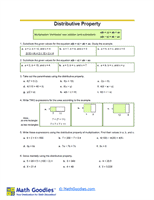
Grade 7 Math Worksheets – You will find a nice collection of exercises on arithmetic with integers and rational numbers, solving algebraic expressions and equations, and understanding geometric concepts like angles, perimeter, area, and volume. Additionally, students will encounter problems involving data analysis, probability, ratios, proportions, and real-world word problems that integrate these mathematical concepts.
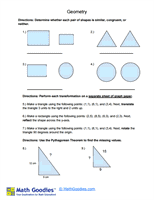
Grade 8 Math Worksheets – This collection of worksheets includes problems involving algebraic expressions and equations, linear functions, geometry, and statistics, such as solving for variables, graphing functions, calculating the properties of geometric shapes, and interpreting data from various charts. Additionally, they often feature real-world application problems that require students to use proportional reasoning, probability, and basic trigonometry.