Addition Rule of Probability
Learn The Addition Rule Of Probability And Adding Probabilities With Example Problems & Interactive Exercises

Experiment: A single 6-sided die is rolled. What is the probability of rolling a 2 or a 5?

Possibilities:
1. The number rolled can be a 2.
2. The number rolled can be a 5.
Events: These events are mutually exclusive since they cannot occur at the same time.
Probabilities: How do we find the probabilities of these mutually exclusive events? We need a rule to guide us.
Addition Rule 1: When two events, A and B, are mutually exclusive, the probability that A or B will occur is the sum of the probability of each event.
P(A or B) = P(A) + P(B)
Let’s use this addition rule to find the probability for Experiment 1.
Experiment 1: A single 6-sided die is rolled. What is the probability of rolling a 2 or a 5?
Probabilities:
| P(2) | = | 1 | ||
| 6 | ||||
 |
||||
| P(5) | = | 1 | ||
| 6 | ||||
|
||||
| P(2 or 5) | = | P(2) | + | P(5) |
|
||||
| = | 1 | + | 1 | |
| 6 | 6 | |||
|
||||
| = | 2 | |||
| 6 | ||||
|
||||
| = | 1 | |||
| 3 | ||||
Experiment 2: A spinner has 4 equal sectors colored yellow, blue, green, and red. What is the probability of landing on red or blue after spinning this spinner?

Probabilities:
| P(red) | = | 1 | ||
| 4 | ||||
|
||||
| P(blue) | = | 1 | ||
| 4 | ||||
|
||||
| P(red or blue) | = | P(red) | + | P(blue) |
|
||||
| = | 1 | + | 1 | |
| 4 | 4 | |||
|
||||
| = | 2 | |||
| 4 | ||||
|
||||
| = | 1 | |||
| 2 | ||||
 Experiment 3: A glass jar contains 1 red, 3 green, 2 blue, and 4 yellow marbles. If a single marble is chosen at random from the jar, what is the probability that it is yellow or green?
Probabilities:
| P(yellow) | = | 4 | ||
| 10 | ||||
|
||||
| P(green) | = | 3 | ||
| 10 | ||||
|
||||
| P(yellow or green) | = | P(yellow) | + | P(green) |
|
||||
| = | 4 | + | 3 | |
| 10 | 10 | |||
|
||||
| = | 7 | |||
| 10 | ||||
In each of the three experiments above, the events are mutually exclusive. Let’s look at some experiments in which the events are non-mutually exclusive.
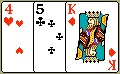 Experiment 4: A single card is chosen at random from a standard deck of 52 playing cards. What is the probability of choosing a king or a club?
Probabilities:
| P(king or club) | = | P(king) | + | P(club) | – | P(king of clubs) |
|
||||||
| = | 4 | + | 13 | – | 1 | |
| 52 | 52 | 52 | ||||
|
||||||
| = | 16 | |||||
| 52 | ||||||
|
||||||
| = | 4 | |||||
| 13 | ||||||
In Experiment 4, the events are non-mutually exclusive. The addition causes the king of clubs to be counted twice, so its probability must be subtracted. When two events are non-mutually exclusive, a different addition rule must be used.
Additional Rule 2: When two events, A and B, are non-mutually exclusive, the probability that A or B will occur is:
P(A or B) = P(A) + P(B) – P(A and B)
In the rule above, P(A and B) refers to the overlap of the two events. Let’s apply this rule to some other experiments.
 Experiment 5: In a math class of 30 students, 17 are boys and 13 are girls. On a unit test, 4 boys and 5 girls made an A grade. If a student is chosen at random from the class, what is the probability of choosing a girl or an A student?
Probabilities: P(girl or A) = P(girl) + P(A) – P(girl and A)
| = | 13 | + | 9 | – | 5 | |
| 30 | 30 | 30 | ||||
|
||||||
| = | 17 | |||||
| 30 | ||||||
 Experiment 6: On New Year’s Eve, the probability of a person having a car accident is 0.09. The probability of a person driving while intoxicated is 0.32 and probability of a person having a car accident while intoxicated is 0.15. What is the probability of a person driving while intoxicated or having a car accident?
Probabilities:
| P(intoxicated or accident) | = | P(intoxicated) | + | P(accident) | – | P(intoxicated and accident) |
|
||||||
| = | 0.32 | + | 0.09 | – | 0.15 | |
| = | 0.26 | |||||
Summary: To find the probability of event A or B, we must first determine whether the events are mutually exclusive or non-mutually exclusive. Then we can apply the appropriate Addition Rule:
Addition Rule 1: When two events, A and B, are mutually exclusive, the probability that A or B will occur is the sum of the probability of each event.
P(A or B) = P(A) + P(B)
Addition Rule 2: When two events, A and B, are non-mutually exclusive, there is some overlap between these events. The probability that A or B will occur is the sum of the probability of each event, minus the probability of the overlap.
P(A or B) = P(A) + P(B) – P(A and B)
Exercises
Directions: Read each question below. Select your answer by clicking on its button. Feedback to your answer is provided in the RESULTS BOX. If you make a mistake, choose a different button.
| 1. | A day of the week is chosen at random. What is the probability of choosing a Monday or Tuesday? |
| 2. | In a pet store, there are 6 puppies, 9 kittens, 4 gerbils and 7 parakeets. If a pet is chosen at random, what is the probability of choosing a puppy or a parakeet? |
| 3. | The probability of a New York teenager owning a skateboard is 0.37, of owning a bicycle is 0.81 and of owning both is 0.36. If a New York teenager is chosen at random, what is the probability that the teenager owns a skateboard or a bicycle? |
| 4. | A number from 1 to 10 is chosen at random. What is the probability of choosing a 5 or an even number? |
| 5. | A single 6-sided die is rolled. What is the probability of rolling a number greater than 3 or an even number? |